
In the delicate chemistry of industrial heat treatment, the atmosphere is everything. If you are bright annealing copper, a single breath of oxygen can ruin the surface finish. If you are carburizing steel gears, the carbon-rich gas that hardens the steel will aggressively attack standard heating elements.
This creates an engineering paradox: How do you heat a load without the heat source ever touching the atmosphere?
The answer lies in Radiant Tube Technology.
At Walta Heater, we engineer complete radiant tube systems—combining high-performance alloy tubes with precision-wound electric elements—to solve this exact problem. This guide explores the mechanics, materials, and maintenance strategies that keep these critical systems running.
1. What is a Radiant Tube Heater?
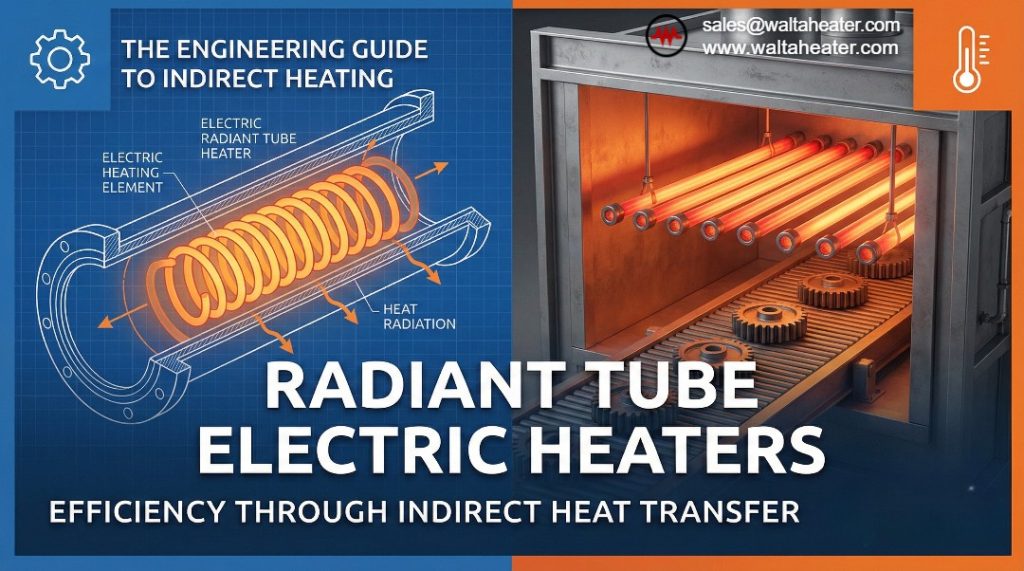
A Radiant Tube Heater is an indirect heating system. Unlike “open” heaters where the coils are exposed to the furnace chamber, the heating element is sealed inside a metal or ceramic tube.
The Working Principle
Generation: The electric element (typically a Bayonet or Bobbin style) generates heat inside the sealed tube.
Radiation: The element radiates this energy to the inner wall of the tube.
Transmission: The tube glows red-hot (up to 1200°C) and radiates thermal energy into the furnace chamber and onto the product (load).
Isolation: The tube acts as a physical barrier. The fragile electric coils are completely isolated from the harsh furnace atmosphere.
2. Why Use Radiant Tubes? The “Atmosphere” Factor
You don’t need radiant tubes for a simple air-drying oven. You need them when the environment is hostile.
A. Protecting the Element (Carburizing/Nitriding)
In processes like Gas Carburizing, the furnace is filled with endothermic gas rich in Carbon. Standard Nichrome wire will absorb this carbon, become brittle, and turn into dust—a phenomenon known as “Green Rot.”
The Radiant Solution: By placing the element inside a sealed tube, the wire remains in a clean air environment, while the rugged alloy tube withstands the carbon attack.
B. Protecting the Load (Bright Annealing)
In Bright Annealing of stainless steel, the finish must be mirror-perfect. Scale or oxide dust falling from an open heating element would ruin the product.
The Radiant Solution: The tube contains all element scaling. The outside of the tube remains smooth and clean, ensuring zero contamination falls on the workpieces.
3. The Heart of the System: Bayonet Heating Elements
While the tube gets the glory, the Bayonet Element inside does the work.
What is a Bayonet Element?
It is a rugged, replaceable heating assembly designed to slide in and out of the radiant tube like a sword in a scabbard.
Ceramic Spine: A central ceramic rod or stack of interlocking spacers holds the thick-gauge resistance wire (Ni-Cr or Fe-Cr-Al).
Plug-and-Play: The “Bayonet” name comes from the mounting method. You can twist and lock it into place.
The Walta Advantage: Our bayonet designs allow you to replace a failed element while the furnace is still hot. You simply pull the old element out of the tube and slide the new one in. No furnace cooldown required.
4. Tube Geometries: Shapes and Efficiency
Radiant tubes come in various shapes to maximize heat transfer within the limits of thermal expansion.
| Shape | Description | Best Application |
| Straight Tube | A single tube open at one end (terminal) and closed at the other. | Small furnaces, or where wall penetration is limited to one side. |
| U-Tube | The tube goes in, makes a U-turn, and comes out the same wall. | Most Common. Allows the tube to expand/contract freely without stress. Improved temperature uniformity. |
| W-Tube (Trident) | Three legs (W shape). | High-capacity furnaces. Provides massive surface area for heat radiation. |
5. Material Selection: Cast vs. Rolled/Seamless
The tube material determines the lifespan of the heater. At Walta Heater, we help you choose between two primary manufacturing methods.
A. Centrifugal Cast Tubes (The Heavyweights)
Material: HK-40, HU, HX alloys.
Pros: Extremely thick walls. Excellent Creep Strength (resistance to sagging) at very high temperatures (>1000°C).
Cons: Expensive molds required. Can be brittle under thermal shock (rapid heating/cooling).
B. Rolled/Seamless Tubes (The Agile Choice)
Material: Rolled and Seamless sheets of Inconel 601, Incoloy 800 or Stainless Steel 310.
Pros: Thinner walls mean better heat transfer. More resistant to thermal shock.
6. Failure Modes: Why Do Tubes Die?
Understanding failure saves money. Here are the top 3 killers of radiant tubes:
Creep (Sagging):
At 1000°C, metal acts like plastic. If the tube supports are too far apart, the tube will slowly bow under its own weight until it cracks.
Fix: Rotational Maintenance. Periodically rotate the tube 180 degrees so gravity bends it back the other way.
Carburization (Metal Dusting):
In carbon-rich atmospheres, carbon diffuses into the tube wall, forming carbides. This makes the metal expand and eventually flake off in layers.
Fix: Use alloys with higher Nickel/Silicon content (like Kanthal APM) which form a protective oxide skin.
Localized Overheating (Hot Spots):
If the internal electric element touches the tube wall (due to sagging), it creates an electrical short or a massive hot spot that melts a hole through the tube.
Fix: Use Walta Heater’s Centered Bayonets with high-purity ceramic spacers that keep the element perfectly aligned in the center of the tube.
7. Quick Takeaways
Atmosphere Control: Radiant tubes are mandatory for Carburizing, Nitriding, and Bright Annealing.
Hot Swap: Electric Bayonet elements can be changed without stopping the furnace.
Material Science: Use Cast Alloys for creep resistance >1000°C; use Fabricated Alloys for thermal shock resistance.
Maintenance: Rotate your tubes 180° every 6 months to double their lifespan.
Green Rot: Sealed tubes prevent the “Green Rot” corrosion that destroys Open Coil heaters.
8. Conclusion
Radiant Tube Heaters are the unsung heroes of high-quality metallurgy. They allow you to heat steel, aluminum, and glass in pristine, controlled environments. But a tube is only as good as the element inside it.
Don’t let a failed bayonet or a cracked tube stop your production line. Upgrade to Walta Heater’s Radiant Systems for superior life and thermal efficiency.
Ready to optimize your furnace?
Contact Walta Heater today. Send us your tube dimensions or element specs, and let our engineering team design a solution that lasts.
9. Frequently Asked Questions (FAQs)
Q1: Can I replace a gas radiant tube with an electric one?
A: Yes. This is a common retrofit. We remove the gas burner and install an electric Bayonet element package. It is quieter, cleaner, and offers better temperature control (PID).
Q2: What is the maximum temperature for a radiant tube?
A: It depends on the alloy. SS310 is good up to 1050°C. Incoloy 800 up to 1100°C. Specialized Kanthal APM or Cast HU alloys can reach 1250°C.
Q3: Why did my new tube crack after one week?
A: This is usually Thermal Shock. If you heat a cast alloy tube too fast (e.g., cold to 1000°C in 1 hour), it will crack. Always follow a “ramp-up” soak procedure.
Q4: How do I know if my inner element is broken?
A: Check the amperage (Current). If the furnace is calling for heat but the Amps on that zone are zero, the element is open (broken).
Q5: What is “Green Rot”?
A: It is the internal oxidation of Chromium in Nickel-Chromium alloys, happening between 800°C-1000°C in reducing atmospheres. It turns the wire green and brittle. Radiant tubes prevent this by isolating the wire.