
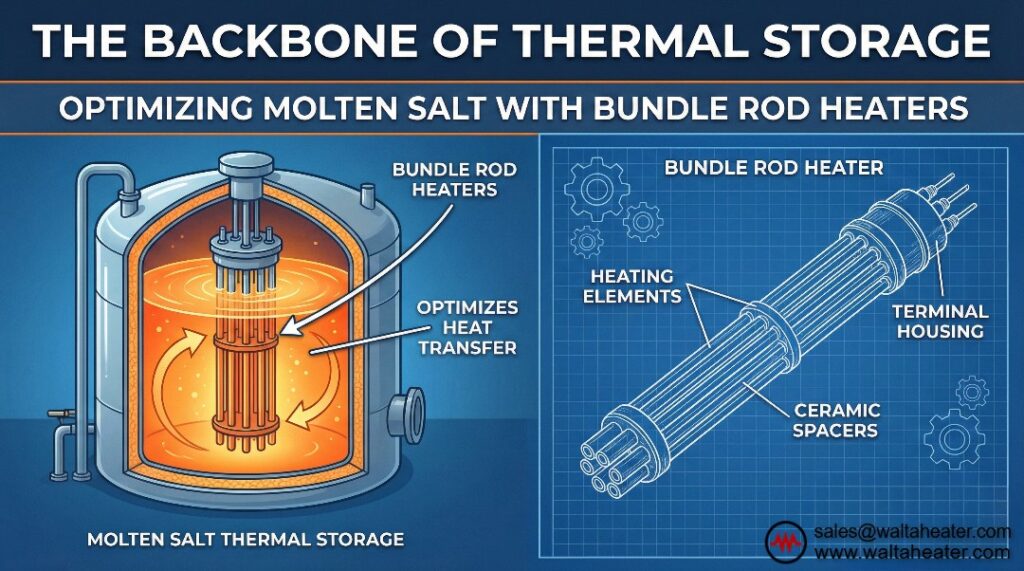
Thermal energy storage (TES) is the unsung hero of the renewable energy revolution, allowing us to bottle the sun’s power for use when the grid goes dark. But inside those massive tanks of molten nitrate salts, a battle against physics is constantly being waged. The salt must remain liquid, often at temperatures exceeding 560°C, without corroding the equipment or suffering from “cold spots” that could freeze the system solid.
Enter the bundle rod heater. Unlike standard immersion heaters that struggle with the mechanical stresses and maintenance nightmares of large-scale storage, Bundle Rod Heaters offer a robust, high-power solution designed specifically for heavy-duty thermal processing. If you are an engineer or facility manager, finding the right Bundle Rod Heater Manufacturer isn’t just a procurement task—it’s a critical step in securing the efficiency and longevity of your energy assets.
What Exactly is a Bundle Rod Heater?
At first glance, a bundle rod heater looks like a complex skeleton. Unlike a solid cartridge heater, it is an assembly of resistance wire elements (rods) supported by a series of ceramic discs or “spacers.” These discs hold the heating elements in a precise circular array around a central support rod.
The Anatomy of the Bundle
The “bundle” design serves two purposes: structural integrity and thermal expansion management.
Ceramic Discs: Usually made of high-purity alumina or steatite, these discs electrically insulate the rods while allowing them to expand and contract freely as temperatures cycle.
Heating Elements: Thick gauge wire or rods (typically 3mm to 8mm diameter) run through the discs. This heavy-duty construction allows them to carry higher currents and last longer than thin coil elements.
How It Differs from Standard Tubular Heaters
Standard tubular heaters consist of a coil compacted in magnesium oxide (MgO) inside a metal sheath. While effective for water, they can develop “hot spots” in viscous fluids like molten salt. Bundle rod heaters, often used inside radiant tubes, radiate heat indirectly. This means the element itself doesn’t touch the corrosive salt, and the large surface area of the Radiant Tube ensures a lower watt density on the salt interface, preventing degradation.
The Molten Salt Challenge: Why Standard Heaters Fail
Heating molten salt is not like boiling water. Nitrate salts (like the Solar Salt mix of 60% NaNO3 and 40% KNO3) have high viscosity near their melting points and can be aggressively corrosive at high temperatures.
Battling Corrosive Nitrate Mixtures
Direct immersion heaters often fail because the sheath material cannot withstand the constant chemical attack of hot nitrates over years of service. If a standard tubular heater sheath cracks, the salt enters the MgO insulation, causing a catastrophic short circuit.
The Risk of “Salt Freezing”
If a heater fails in a molten salt tank, you are on a ticking clock. If the salt freezes (usually around 220°C-240°C), it contracts and then expands upon re-melting, which can crush internal components and rupture tanks. You need a heating system that is reliable and, crucially, repairable while the system is still hot.
Why Bundle Rod Heaters are the Top Choice for TES
The primary reason engineers specify bundle rod heaters for CSP (Concentrated Solar Power) and industrial heat storage is maintainability.
Ease of Maintenance: The “Replace Without Draining” Advantage
This is the game-changer. Bundle rod heaters are typically installed inside a sealed metal or ceramic radiant tube that penetrates the tank wall.
Scenario: A heating element burns out.
With Standard Immersion Heaters: You must drain the tank (a massive, dangerous operation) or pull a heavy flange that exposes open molten salt to air.
With Bundle Rod Heaters: You simply disconnect the electrical leads, slide the old ceramic bundle out of the radiant tube, and slide a new one in. The tank remains full, the salt remains sealed, and the process continues uninterrupted.
Insight: For a 100MW CSP plant, the ability to replace a heater element without draining the salt tank can save hundreds of thousands of dollars in downtime and operational risk.
Material Matters: Selecting the Right Alloys
When evaluating a bundle rod heater manufacturer, their choice of resistance alloy is your first vetting question.
NiCr vs. FeCrAl
NiCr (Nickel-Chromium): Common grades like NiCr 80/20 are excellent for temperatures up to 1200°C. They offer good ductility (resistance to becoming brittle after use) and high creep strength.
FeCrAl (Iron-Chromium-Aluminum): Alloys like Kanthal® APM can withstand temperatures up to 1425°C. For High-Temperature salt applications, FeCrAl is often preferred because it forms a protective aluminum oxide layer that resists chemical attack better than the chromium oxide on NiCr.
Integration with Radiant Tubes: A Perfect Match
The radiant tube acts as the shield. By decoupling the heating element from the fluid, you gain two advantages:
Corrosion Immunity: The heating element never touches the salt.
Surface Area Maximization: The radiant tube has a larger diameter than the heating rods, providing a large surface area to transfer heat into the salt. This allows you to run the internal heater at high power while keeping the “watt density” on the tube surface low (typically < 2-3 W/cm²), which protects the salt from chemical decomposition.
Critical Design Parameters for Molten Salt Tanks
Determining Optimal Surface Load
Watt density (Surface Load) is critical. If the heater surface gets too hot, the nitrate salt can decompose into nitrite or even solid oxides, creating a sludge that insulates the heater and causes failure.
Target: For molten salt, a surface watt density of 2.0 to 3.5 W/cm² on the radiant tube is standard.
Manufacturer Role: A top-tier manufacturer will calculate the internal bundle geometry to ensure the radiating heat flux matches this requirement exactly.
Operational Efficiency and Control Strategies
Using bundle rod heaters requires sophisticated control. You cannot simply plug them into a wall socket.
Thyristor Control and Temperature Ramping
“Bang-bang” (On/Off) controls are detrimental to heater life due to thermal cycling fatigue. Thyristor (SCR) power controllers are essential. They modulate the voltage to provide a smooth, continuous power output. This is vital during the “melt-out” phase, where power must be trickled in slowly to melt solid salt without overheating the liquid pockets.
Case Applications: From CSP to Industrial Heat Treatment
While CSP is the headline act, bundle rod heaters are workhorses in other sectors:
Metal Heat Treatment: Used in salt bath furnaces for annealing and hardening steel parts.
Chemical Processing: Heating reactors where fluid integrity is paramount and direct immersion is unsafe.
Waste Heat Recovery: Pre-heating fluids in hybrid storage systems.
Selecting a Bundle Rod Heater Manufacturer
Not all heaters are created equal. When sourcing a vendor, look for these markers of quality:
Custom Voltage/Frequency: Can they design for 690V industrial grids common in power plants?
Ceramic Quality: Do they use high-alumina ceramics that resist thermal shock, or cheap steatite that cracks?
Spares Availability: Can they ship replacement bundles in 48 hours?
Simulation Capabilities: Do they offer thermal modeling to predict the heater’s lifespan in your specific tank geometry?
Quick Takeaways
Maintainability is King: Bundle rod heaters can be replaced without draining the salt tank, a massive operational advantage.
Indirect Heating: Using radiant tubes protects the element from corrosive salts and allows for better watt density management.
Material Choice: FeCrAl alloys are generally superior for high-temperature applications due to alumina oxide protection.
Control is Critical: Always use SCR/Thyristor controls to prevent thermal shock and salt degradation.
Watt Density: Keep radiant tube surface load under 3.5 W/cm² to prevent salt decomposition.
Structure: The ceramic disc “bundle” design allows for thermal expansion that would destroy rigid heaters.
Conclusion: Securing Your Thermal Assets
The efficiency of a molten salt storage system is defined by its weakest link. Often, that link is the heating element buried deep inside the tank. By moving away from standard immersion heaters and adopting bundle rod heaters housed in radiant tubes, you are investing in longevity, safety, and operational uptime.
Whether you are retrofitting an annealing furnace or designing a gigawatt-scale CSP plant, the right bundle rod heater manufacturer is a partner in your plant’s reliability. Don’t just buy a heater; buy a thermal solution that respects the unique chemistry and physics of molten salt.
Ready to optimize your thermal storage system? Start by auditing your current heater watt densities and exploring a retrofit to bundle rod technology for your next maintenance cycle.
FAQs
1. Can bundle rod heaters be installed horizontally in large tanks? Yes, but support is crucial. Horizontal installations require ceramic spacers to be closely spaced to prevent the rods from sagging between supports when they heat up and expand. The radiant tube itself must also be adequately supported within the tank.
2. What is the typical life expectancy of a bundle rod heater in molten salt service? With proper thyristor control and radiant tube protection, bundle rod elements can last 3-5 years or more. The radiant tubes themselves can last significantly longer, often 10+ years, depending on the salt chemistry.
3. Why are bundle rod heaters more expensive than tubular elements? The initial CapEx is higher due to the complex assembly of ceramic discs, heavy-gauge alloy rods, and the required radiant tubes. However, the OpEx is significantly lower due to reduced maintenance downtime and longer service life.
4. How do I calculate the required power for my molten salt tank? You need to calculate the heat up time (mass × specific heat × temp rise / time) plus the thermal losses through the tank insulation. A bundle rod heater manufacturer can usually run this thermal model for you.
5. Are there specific salts that are incompatible with radiant tubes? Standard Stainless Steel (304/316) tubes work for nitrate salts up to 500°C. For chlorides or fluorides (next-gen high-temp salts), you will need exotic nickel-alloys like Inconel or Hastelloy for the radiant tubes to prevent rapid corrosion.
We’d Love to Hear From You! Have you faced challenges with heater corrosion in your thermal storage systems? Share your experiences or questions in the comments below—let’s discuss how robust heating design can solve these operational headaches.