
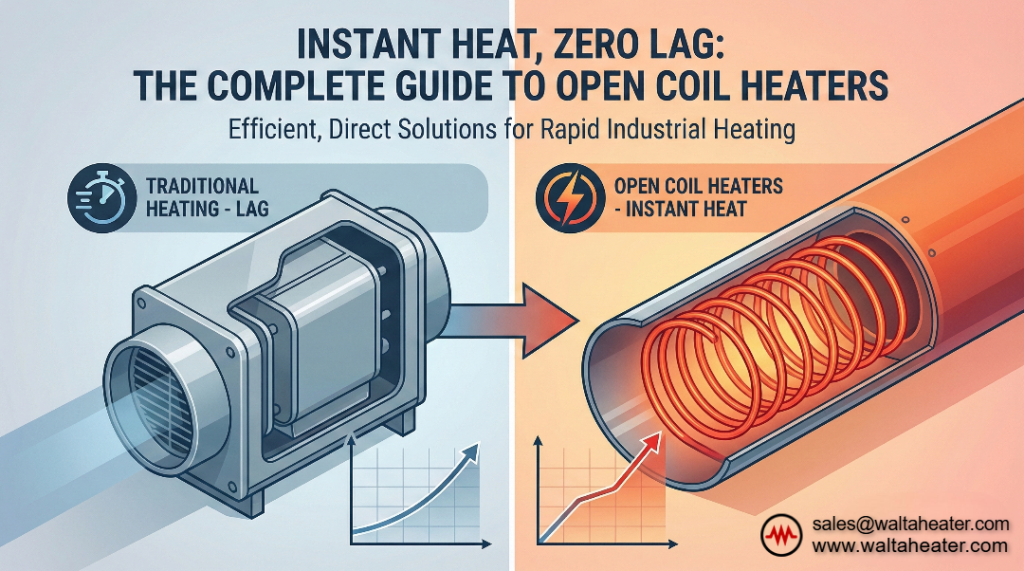
In the world of thermal engineering, “Thermal Lag” is the enemy of precision. When you turn on a standard tubular heater, you wait for the wire to heat the powder, the powder to heat the sheath, and the sheath to heat the air. By the time the air is hot, your process—or your patient in a hospital room—might be freezing.
When you need instant heat and minimal air resistance, there is only one solution: The Open Coil Heater.
At Walta Heater, we manufacture these rapid-response elements for applications ranging from massive commercial HVAC ducts to precision industrial drying ovens. While they look simple, the engineering behind the coil winding, support spacing, and ceramic selection is what separates a heater that lasts 10 years from one that sags in 10 days.
This guide explores the mechanics, advantages, and critical safety protocols of Open Coil Heaters, helping you decide if “going open” is the right move for your system.
1. What is an Open Coil Heater? (The Anatomy)
As the name implies, an Open Coil Heater exposes the resistance wire directly to the airflow. Unlike a tubular heater, there is no metal sheath, no compressed magnesium oxide (MgO), and no protective barrier.
The Mechanics of Direct Contact
The Element: A resistance wire (typically Nichrome 80/20 or Kanthal A1) is wound into a spring-like coil.
The Support: This coil is threaded through Steatite ceramic insulators. These ceramics prevent the “live” coil from touching the metal frame while holding it suspended in the air stream.
The Frame: The entire assembly is mounted in a galvanized or stainless steel frame that slides directly into a duct or oven.
Because the wire is exposed, 100% of the heat is transferred directly to the air via convection the moment the current flows.
2. The Physics of Speed: Why “Open” Wins on Efficiency
1. Zero Thermal Inertia
Thermal inertia is the resistance to temperature change. A finned tubular heater is heavy; it holds heat. When you turn it off, it stays hot for minutes (overheating your product).
An Open Coil Heater has low mass. It reaches full operating temperature in seconds and cools down just as fast. This makes it ideal for PID-controlled systems requiring ±1°C accuracy.
2. Minimal Pressure Drop
In HVAC, every inch of static pressure counts. Pushing air past a dense bank of finned tubes requires a powerful (and expensive) fan. Open coils are mostly empty space. Air flows through them with negligible resistance, allowing you to use smaller fans and save on motor electricity costs.
3. Open Coil vs. Finned Tubular: The Showdown
This is the most common question we get at Walta Heater: “Which element should I choose?”
| Feature | Open Coil Heater | Finned Tubular Heater |
| Response Time | Instant (< 10 Seconds) | Slow (2-5 Minutes) |
| Safety | Live voltage exposed (Shock Hazard) | Fully insulated (Safe to touch) |
| Pressure Drop | Very Low | High |
| Durability | Sensitive to debris/moisture | Robust, splash-proof |
| Cost | Generally Lower | Higher |
| Best Environment | Clean, Dry Air (HVAC) | Humid, Dusty, or Accessible Areas |
The Verdict: If the air is clean and you need fast control (HVAC, Drying), go Open Coil. If there is a risk of someone touching the element or water spray (Greenhouses), use Finned Tubular.
4. Critical Design Parameters
You cannot just stretch a wire and hope it works. At Walta Heater, we calculate three specific variables:
A. Watt Density (W/in²)
This is the heat intensity on the wire surface.
Low Velocity Air: We use a lower watt density to prevent the wire from glowing red-hot and oxidizing.
High Velocity Air: We can push the watt density higher because the fast air “scrubs” the heat away.
B. The “Stretch Ratio”
This is the distance between the coils.
Too Tight: Heat gets trapped between the winds, causing a hot spot and burnout.
Too Loose: The coil becomes floppy and may sag.
Walta Standard: We maintain a strictly calculated stretch ratio (typically 3:1) to ensure turbulent airflow around the wire without compromising structural integrity.
C. Ceramic Spacing
Gravity is the enemy. As the wire heats up, it expands and softens. If the ceramic supports are too far apart, the coil will droop. If it touches the coil below it, BOOM—short circuit. We place supports at frequent intervals to prevent this “sag.”
5. Installation & Safety: The “Live” Wire Warning
Because the heating element carries 230V/415V and is exposed, you must follow strict safety protocols.
Airflow Interlock (Crucial): You must install a differential pressure switch or airflow sensor. The heater control circuit should only energize if the fan is running. If the fan stops and the heater stays on, the wire will melt in seconds.
Upstream Screening: Install a mesh screen before the heater to catch debris. A piece of paper or fiberglass insulation sucked into an open coil heater acts like a matchstick.
Grounding: The metal frame must be earth-grounded. If a ceramic breaks and the live coil touches the frame, the breaker must trip immediately.
6. Troubleshooting: Why Do Coils Fail?
If your open coil heaters are burning out frequently, check these culprits:
Evaporator Coil Proximity: In HVAC, if the heater is too close to the cooling coil (A-coil), water droplets can blow onto the live wire, causing an immediate short.
Cycling Fatigue: If your thermostat clicks on/off every 10 seconds, the constant expansion and contraction will work-harden the wire, causing it to snap. Solution: Use a Solid State Relay (SSR) for smoother power modulation.
Dust Accumulation: A layer of dust on the wire acts as insulation. The wire overheats underneath the dust jacket.
7. Why Source from Walta Heater?
Walta Heater Pvt Ltd provides more than just coiled wire. We engineer thermal solutions.
Custom Frames: We fabricate the galvanized steel or stainless steel frames to slide perfectly into your existing ductwork, whether it’s a square duct or a round transition.
Offset Coils: We can wind coils with “offset” patterns to maximize turbulence and heat transfer in compact spaces.
Rapid Replacement: A broken HVAC heater means a freezing building. We can manufacture replacement coil kits in 1 week.
8. Quick Takeaways
Speed: Open Coil heaters offer the fastest thermal response of any electric heater.
Efficiency: Direct contact with air means near 100% efficiency and low pressure drop.
Risk: They are exposed “live” elements—keep them away from water and conductive debris.
Safety: Always use an airflow switch interlock.
Construction: Ceramic insulator spacing is critical to prevent sagging.
Application: Ideal for HVAC ducts, braking resistors, and high-precision drying ovens.
9. Conclusion
For pure efficiency and speed in air heating, the Open Coil Heater is unrivaled. It is the sprinter of the heating world—light, fast, and responsive. However, it demands respect regarding airflow and cleanliness.
Need to upgrade your HVAC heating banks?
Contact Walta Heater today. We will calculate the pressure drop and heat transfer requirements to build a system that breathes easy and heats fast.
10. Frequently Asked Questions (FAQs)
Q1: Can I repair a broken open coil heater wire?
A: Technically, yes, by spot welding or using a crimp sleeve. However, stretching the remaining wire to bridge the gap creates a “hot spot” (higher resistance per inch), and it will likely fail again soon. Replacement is safer.
Q2: What is the minimum air velocity required?
A: It depends on the watt density, but generally, we recommend a minimum of 300-400 FPM (Feet Per Minute) to ensure the wire doesn’t overheat.
Q3: Can these heaters be used in high-humidity areas?
A: No. Condensation on the ceramics can cause arcing. For humid environments (like bathrooms or greenhouses), use Finned Tubular Heaters.
Q4: Do open coil heaters emit a smell?
A: Only on the very first startup (burning off manufacturing oils) or if dust has accumulated on them. A burning smell during normal operation usually indicates low airflow.
Q5: What is the maximum temperature for an open coil?
A: The standard Nichrome wire can withstand up to 1100°C, but the air temperature is usually limited by the duct insulation and frame material, typically to around 300°C-400°C max for these assemblies.