
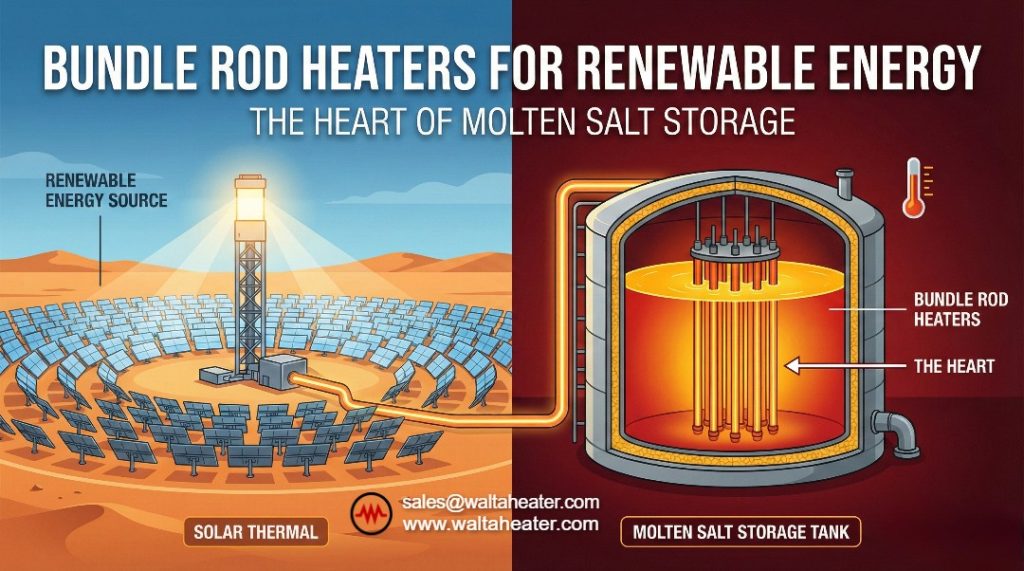
In the rapidly changing world of green infrastructure, Bundle Rod Heaters for Renewable Energy have become a key technology for Long-Duration Energy Storage (LDES). As the world moves from fossil fuels to renewables like solar and wind, we must store energy efficiently. Molten Salt Energy Storage (MSES) offers a great solution because it acts as a massive thermal battery. However, the system’s success depends entirely on one part: the heating element.
This article explains why bundle rod heaters are the best choice for MSES systems. We will look at their design, benefits, and their role in the future of power.
1. The Renaissance of Thermal Energy Storage
The global push for net-zero carbon emissions has shown the limits of lithium-ion batteries. Specifically, batteries are expensive and they degrade over time when we use them for grid-level storage. Therefore, Molten Salt Energy Storage is gaining popularity. Originally, engineers developed this for Concentrated Solar Power (CSP) plants. Now, however, they are adapting MSES for standalone “Power-to-Heat” (P2H) projects. In these projects, the system converts excess wind or solar energy into heat and stores it in molten salt.
For this process to work well, Bundle Rod Heaters for Renewable Energy are necessary. Unlike standard heaters, manufacturers design these advanced units to handle extreme heat and harsh salts. Consequently, they bridge the gap between making electricity and storing heat.
2. What Are Bundle Rod Heaters?
A Bundle Rod Heater is a strong, high-temperature electric heater made for heavy industry. Its design is different from standard tube heaters.
Ceramic Support: A series of ceramic discs supports the heating wire. This “bundle” structure allows the rods to expand and contract freely. This is important because the rods get very hot, reaching up to 1250°C.
Radiant Tube Integration: In most cases, the bundle rod fits into a protective radiant tube. This tube keeps the heater safe from the salt. Furthermore, it allows maintenance teams to fix the heater without draining the tank.
Power Density: These heaters deliver high power (up to 100 kW per unit). As a result, they work perfectly for the large tanks used in MSES.
Design Specifics for Molten Salt
When engineers choose Bundle Rod Heaters for Renewable Energy, they must look at specific materials:
Element Material: Most experts prefer Ferritic alloys (FeCrAl) because they resist rust at high heat.
Sheath Material: You should use Incoloy 800H or Stainless Steel 310 to stop damage from the salts at 565°C.
3. The Critical Role in the Molten Salt Lifecycle
A molten salt plant works correctly only if it stays within specific temperature ranges. Bundle Rod Heaters for Renewable Energy perform three main jobs:
A. Freeze Protection (The Anti-Crystallization Defense)
Molten “Solar Salt” freezes at about 220°C (428°F). If the salt turns solid in the pipes, it can break the system. Therefore, bundle rod heaters provide the steady heat needed to keep the salt liquid during the night or cloudy days.
B. Power-to-Heat Charging
In hybrid plants, the system uses extra electricity to “charge” the thermal battery. Bundle rod heaters heat up quickly to raise the salt temperature from the “Cold Tank” level (~290°C) to the “Hot Tank” level (~565°C). This task needs heaters that respond fast and handle high heat.
C. Cold Start-up
When a new plant starts, operators must melt tons of solid salt flakes. This process needs a slow, controlled start to protect the tank walls. Fortunately, the control systems paired with bundle rod heaters manage this easily.
4. Technical Advantages Over Immersion Heaters
Why should a buyer choose Bundle Rod Heaters for Renewable Energy over cheaper options?
| Feature | Bundle Rod Heater | Tubular Immersion Heater |
| Maintenance | Replaceable without draining. You can pull the element from the tube while the tank is full. | You must drain the tank to replace it. |
| Heat Transfer | Primarily Radiant. The element heats the tube, which then heats the salt. | Direct contact. This often causes scaling and hot spots. |
| Longevity | High. Ceramic supports stop the wire from sagging. | Moderate. Elements can bend and break. |
| Voltage | Handles Medium Voltage (up to 690V) directly. | Usually limited to lower voltages (480V). |
Engineer’s Insight: The biggest benefit is the ability to replace a heater without draining the tank. If you have to drain a 5,000-ton tank, it can take days and cost a lot of money.
5. Engineering Challenges and Solutions
Using Bundle Rod Heaters for Renewable Energy does come with challenges. However, top manufacturers have solved these issues:
Managing Watt Density
If the heater gets too hot in one spot, the salt nearby can break down. To fix this, high-quality designs use Multi-Zone Heating. Engineers wind the wire differently to lower the heat at the bottom of the tank while keeping high power elsewhere. This ensures the salt stays stable.
Corrosion Resistance
At 565°C, nitrate salts cause rust. The bundle rod itself is safe inside the tube, but the outer tube touches the salt.
Solution: Use Aluminized Steel or Incoloy tubes. These metals form a protective layer that stops salt damage.
Thermal Expansion
A 5-meter long heater can grow by several centimeters when it gets hot.
Solution: Bundle rod heaters use a floating ceramic head. This design lets the internal rods move without breaking the mounting flange.
6. Installation & Configuration Strategies
For Bundle Rod Heaters for Renewable Energy to work best, you must place them correctly.
Horizontal vs. Vertical: Vertical installation from the roof is better for deep tanks because it stops leaks. However, horizontal installation works well for smaller tanks.
Ullage Heating: Sometimes, engineers place bundle rod heaters in the air space above the salt. They heat the salt surface to stop a crust from forming. Standard heaters cannot do this.
7. Future Trends: The LDES Market
The market for Bundle Rod Heaters for Renewable Energy will grow as the energy sector grows. As industries try to lower carbon usage, we see these heaters in new places:
Industrial Process Heat: Factories are replacing gas furnaces with electric molten salt systems.
Carnot Batteries: Companies are turning old coal plants into thermal storage sites. They use existing turbines and new salt tanks heated by bundle rods.
Quick Takeaways
Bundle Rod Heaters for Renewable Energy are the best choice for Molten Salt Storage because they are reliable and easy to fix.
Zero-Drain Maintenance: You can replace them without emptying the tank, which saves money.
High Temperature: They work well above 1000°C, so they easily handle solar salt at 565°C.
Versatility: They are great for freeze protection, start-up melting, and charging cycles.
Material Science: Ceramic supports and special alloys ensure they last a long time.
Conclusion
As the energy grid relies more on renewables, we need stable storage like Molten Salt Energy Storage. However, a storage system is only as good as its heater. Bundle Rod Heaters for Renewable Energy provide the strong, scalable, and easy-to-maintain solution that engineers need. If plant operators choose heaters with radiant tubes and zone control, they ensure their plant runs for 25+ years. Consequently, this protects their investment and stabilizes the green energy grid.
Are you designing a thermal storage system? Focus on heater maintenance to protect your future operations.
Frequently Asked Questions (FAQs)
1. What is the max temperature for Bundle Rod Heaters in molten salt?
The heaters can reach 1250°C. However, in Bundle Rod Heaters for Renewable Energy projects, controls keep the salt between 290°C and 565°C to stop it from breaking down.
2. Can I replace Bundle Rod Heaters while the system is running?
Yes, if you install them inside a radiant protection tube. This design lets you remove the heater without touching the molten salt. Therefore, you do not need to shut down the system.
3. Why do engineers prefer Bundle Rod Heaters over tubular heaters?
The main reasons are Power Density and Maintenance. Bundle rod heaters fit more power into a smaller space. Additionally, they last longer in hot, vibrating environments.
4. What materials stop corrosion in these heaters?
Manufacturers make the internal wire from Kanthal or Nichrome. However, the outer tube is the most important part. It is usually Incoloy 800H or SS 310 to fight the corrosive nitrate salts.
5. How do these heaters help with Grid Balancing?
They act as the charging unit. When the plant uses Bundle Rod Heaters for Renewable Energy with extra wind or solar power, it stores that energy as heat. Later, the plant can turn that heat back into electricity to stabilize the grid.