
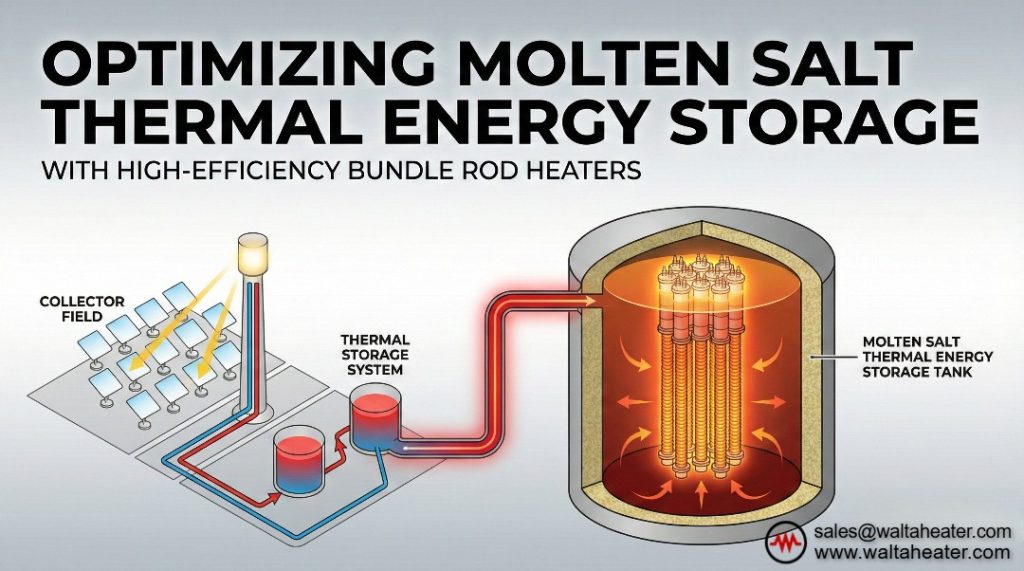
In the high-stakes arena of Concentrated Solar Power (CSP) and metallurgical heat treatment, the nightmare scenario isn’t just a power outage—it’s a “freeze event.” When molten salt solidifies in the lines or tanks, it expands, rupturing pipes and costing millions in downtime. The defense against this catastrophe? A robust, maintainable, and highly efficient thermal engine.
For industrial plant managers and maintenance engineers, the choice of heating element is often an afterthought—until it fails. As the industry pivots towards decarbonization and 24/7 renewable energy storage, the demand for reliable High-Temperature heating has never been higher.
This guide explores why Bundle Rod Heaters (housed within radiant tubes) have emerged as the superior technical solution for molten salt applications. We will dissect the engineering behind these systems, calculate the efficiency gains, and demonstrate why choosing a specialized Bundle Rod Heater Manufacturer like Waltaheater Private Limited can secure your facility’s operational uptime.
1. The Thermal Challenge: Why Molten Salt is Different
Molten salts (typically nitrate/nitrite mixtures for CSP or chloride salts for heat treatment) are not just hot liquids; they are aggressive, high-density thermal batteries. Heating them presents three specific engineering hurdles that standard immersion heaters fail to clear:
Corrosive Attack: At 560°C (1040°F), nitrate salts can rapidly corrode standard stainless steel sheaths if the watt density is too high, leading to catastrophic element failure and short circuits.
The “Sludge” Factor: In salt bath furnaces used for steel hardening, metal scale and impurities settle at the bottom. Direct immersion heaters often get buried in this sludge, overheating because they cannot dissipate heat, eventually burning out.
The Maintenance Trap: Replacing a direct immersion heater requires draining the tank—a dangerous, days-long process involving pumps, trace heating, and massive safety risks.
2. The Bundle Rod Solution: Anatomy of Efficiency
A Bundle Rod Heater is not a simple coil; it is a precision-engineered thermal assembly designed for heavy-duty indirect heating.
Design Breakdown
Ceramic Core: Unlike tubular heaters that use compacted MgO powder, bundle rod heaters utilize a series of interlocking ceramic discs (steatite or high-alumina) stacked on a central support rod.
Heating Element: Heavy-gauge resistance wire (Nichrome 80/20 or Kanthal A1) is wound in spirals/straight rods and supported by the ceramic discs. This “open” structure allows for free thermal expansion and contraction without mechanical stress.
Radiant Transfer: The heater is inserted into a Radiant Tube (a sealed metal or ceramic pipe). The element heats the tube, and the tube heats the salt.
Key Insight: The primary innovation here is decoupling. The electrical component is mechanically and chemically separated from the process fluid.
3. Radiant Tubes: The First Line of Defense
For molten salt applications, the radiant tube is as critical as the heater itself. By acting as a barrier, it allows the use of Bundle Rod Heaters in environments that would destroy a standard element in hours.
Material Selection: For nitrate salts (up to 600°C), Stainless Steel 310 or Incoloy 800 radiant tubes are standard. For higher temperature chloride baths (up to 1000°C), specialized cast alloy tubes are used.
Vertical vs. Horizontal: In deep TES tanks, heaters are often mounted vertically. Waltaheater engineers these systems with specialized ceramic spacers to prevent the heating coil from “slumping” due to gravity at high temperatures. Vertical installation from the roof is better for deep tanks because it stops leaks. However, horizontal installation works well for smaller tanks.
4. Zero-Downtime Maintenance: A Game Changer
The most compelling argument for switching to a Bundle Rod Heater Manufacturer solution is maintainability.
Imagine a heater fails in your 5,000-liter salt storage tank.
With Immersion Heaters: You must shut down, cool the salt (carefully, so it doesn’t freeze), drain the tank, unbolt the flange, replace the heater, refill, and reheat. Total downtime: 3-5 days.
With Bundle Rod Heaters: You isolate the electrical panel, unbolt the terminal box, slide out the failed ceramic bundle, and slide in a new one. The radiant tube remains in the tank, sealing the salt. Total downtime: 30 minutes.
The salt never stops flowing. For CSP plants generating power for the grid, this reliability is non-negotiable.
5. Optimizing Watt Density for Longevity
One of the most frequent questions we receive at Waltaheater is, “How long will it last?” The answer lies in Watt Density (Surface Load).
In molten salt, heat transfer is governed by convection. If you pump too much power through a small surface area, the salt in immediate contact with the tube can decompose or boil, creating a gas film that insulates the tube and causes it to overheat (the Leidenfrost effect).
Recommended Watt Density: For nitrate salts, we recommend a surface load of 2.0 to 2.5 W/cm² on the radiant tube surface.
Thyristor Control: We strongly advise using SCR (Silicon Controlled Rectifier) power controllers. These allow for a “Soft Start” feature, baking out any moisture in the heater and gently warming the tube before full power is applied, preventing thermal shock.
6. Energy Efficiency and Cost Analysis
While electric heating is often seen as more expensive than gas, the system efficiency of Bundle Rod Heaters tells a different story.
100% Thermal Conversion: Resistance heating is 100% efficient at the source.
Zero Flue Gas Loss: Unlike gas burners, which lose 20-30% of heat through the exhaust stack, electric bundle rods transfer all generated energy into the application (minus minor shell losses).
Demand Response: For renewable energy projects, electric heaters can be powered by excess solar/wind energy, effectively turning the salt tank into a battery.
7. Waltaheater: The Indian Advantage
Sourcing industrial heating elements typically involves a choice: expensive imports with 8-12 week lead times, or unreliable generic replacements.
Waltaheater Private Limited, based in India, bridges this gap.
Rapid Manufacturing: We can manufacture custom-length bundle rod elements (up to 4+ meters) in days, not weeks.
Metallurgy: We understand the specific grades of alloy and ceramics available in the market, ensuring your spare parts supply chain is resilient.
Custom Retrofits: Got an old furnace with odd dimensions? We can reverse-engineer a bundle rod solution to fit your existing radiant tubes.
8. Applications Beyond Solar: Industrial Salt Baths
While TES is a growing market, the “bread and butter” application for these heaters remains the metallurgical salt bath.
Austempering: Producing tough, ductile iron requires precise temperature holding at ~350°C. Bundle rod heaters provide the uniform, gentle heat needed to prevent distortion in critical automotive parts.
Descaling: In stainless steel production, molten salt baths are used to descale strips. The robust nature of bundle rod heaters makes them immune to the aggressive splashing and vibration of these lines.
9. Safety Protocols for Molten Salt Heating
Safety is paramount. When designing your heating system, consider these redundancies:
Over-Temperature Sensors: Install thermocouples not just in the salt, but on the heating element itself. This protects the heater in case of a pump failure where flow stops.
Level Switches: Never energize a heater if the salt level has dropped below the active zone.
Moisture Management: As a Bundle Rod Heater Manufacturer, we ship elements in sealed packaging, but we always recommend a low-voltage “bake out” cycle upon installation to remove any hygroscopic moisture absorbed by the ceramic.
10. Conclusion: The Smart Investment for Thermal Storage
The transition to advanced thermal storage and high-quality heat treatment is not just about buying a tank and some salt. It is about engineering a system that can survive the harsh realities of 600°C operation year after year.
Bundle Rod Heaters offer the perfect synergy of performance and practicality. They deliver high power density, protect themselves from the corrosive environment, and turn a potential multi-day breakdown into a simple 30-minute maintenance task.
As your partner in thermal engineering, Waltaheater is ready to help you optimize your furnace or storage system. Whether you are building a new CSP plant or retrofitting an old salt bath, our made-in-India solutions ensure you have the heat you need, exactly when you need it.
Quick Takeaways
Zero Downtime: Bundle Rod Heaters can be replaced without draining the molten salt tank.
Corrosion Immunity: The heater element never touches the salt; it is protected by a radiant tube.
High Efficiency: Electric resistance heating offers near 100% source-to-heat conversion.
Custom Fit: Waltaheater manufactures elements to exact length and voltage specifications.
Safety First: Indirect heating eliminates the risk of salt leaking into the electrical element.
Ideal for TES: Perfect for Concentrated Solar Power (CSP) and grid-storage thermal batteries.
Local Support: Rapid lead times for spares compared to European imports.
Frequently Asked Questions (FAQs)
Q1: Can I replace my existing tubular immersion heaters with Bundle Rod Heaters? A: Yes, but it requires retrofitting the tank with radiant tubes (wells). Once the tubes are welded or flanged into place, you can switch to bundle rod elements for all future operations, gaining the benefit of drain-free maintenance.
Q2: What is the maximum operating temperature for these heaters? A: The bundle rod element itself can withstand internal temperatures up to 1100°C (using Kanthal wire). However, in molten salt applications, the limiting factor is usually the salt chemistry and the radiant tube material, typically capping operations around 600°C-700°C.
Q3: How do you prevent the ceramic discs from breaking in horizontal installations? A: For horizontal setups longer than 1 meter, we use specialized support discs with tighter tolerances and thicker center rods to minimize sagging. However, we recommend vertical installation for very long elements whenever possible to eliminate bending stress.
Q4: Do these heaters require a specific type of control panel? A: Yes. We strongly recommend Thyristor (SCR) power controllers with a “soft start” function. This ramps up the voltage slowly, baking out moisture and preventing thermal shock to the ceramic and radiant tube during cold starts.
Q5: What is the typical lead time for a custom Bundle Rod Heater from Waltaheater? A: Unlike imported heaters that can take 12-16 weeks, our India facility can typically manufacture and ship custom replacements in 4-6 weeks, depending on the complexity and quantity.
Let’s Heat Up Your Process
Are you struggling with frequent heater failures or dreading the next maintenance shutdown? Share your current furnace challenges in the comments below or contact our engineering team directly.
Ready to upgrade? Visit www.waltaheater.com to request a technical drawing or quote today.