
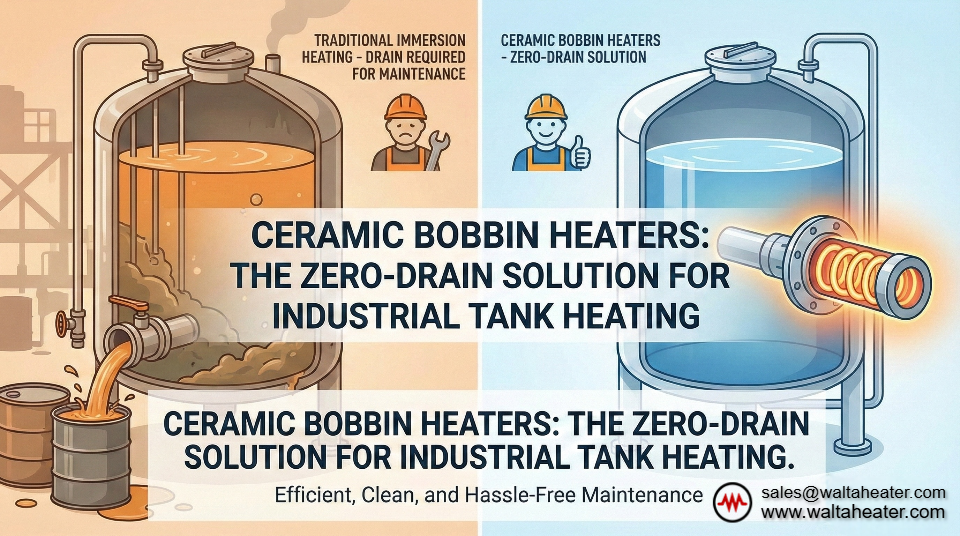
Imagine this scenario: It is 3:00 AM. The heating element in your primary bitumen storage tank has failed. To replace the standard immersion heater, you have to drain 20,000 liters of hot, viscous fluid, clean the sludge, unbolt the flange, and pray the new seal holds. That is three days of downtime and thousands of dollars in lost production.
Now, imagine the same failure with a Ceramic Bobbin Heater. You walk up to the tank, disconnect the power, pull the old element out of its protection tube, slide a new one in, and turn the power back on. Total downtime: 15 minutes. No draining. No mess.
At Walta Heater, we understand that in industries like Oil & Gas, Chemical Processing, and Road Construction, reliability isn’t a luxury—it’s a necessity. This guide is your definitive resource for understanding, selecting, and maintaining Ceramic Bobbin Heaters for maximum efficiency.
1. What is a Ceramic Bobbin Heater?
1.1 The Anatomy of the Element
Unlike standard tubular heaters where the resistance wire is embedded in compacted Magnesium Oxide (MgO) powder, a Ceramic Bobbin Heater is an “open” element design.
The Core: It consists of cylindrical refractory ceramic blocks (bobbins) stacked onto a central support rod.
The Winding: High-grade resistance wire (typically Nichrome) is wound through the outer grooves of these ceramic blocks.
The Structure: This creates a large surface area heater that is structurally rigid and capable of radiating intense heat.
1.2 The Indirect Heating Mechanism
The defining feature of this technology is that the heater never touches the liquid. The bobbin element is inserted into a protection tube (also called a pocket or sheath) that is welded into the tank. The heater radiates heat to the inner wall of the tube, and the tube conducts that heat into the surrounding liquid.
2. Why Choose Bobbin Heaters? The Strategic Advantage
2.1 Maintenance Without Draining
For Facility Managers, this is the primary ROI factor. Since the protection tube remains sealed in the tank, the heating element can be removed and replaced without emptying the vessel. This makes them the industry standard for large storage tanks.
2.2 High Surface Area Efficiency
The segmented design allows for a large surface area relative to the heater’s length. This enables Low Watt Density heating (discussed in Section 4), which is critical for heating viscous fluids that damage easily.
2.3 Modular Repair
In some large-scale custom designs, if a section of the ceramic breaks, the heater can be disassembled and rebuilt using spare bobbins, unlike tubular heaters which must be scrapped entirely if they fail.
3. Critical Applications in Industry
3.1 Bitumen & Asphalt Storage
Bitumen is heat-sensitive. If you heat it too aggressively, it “cokes” (burns) onto the heater surface, creating an insulating layer of carbon that eventually destroys the heater. Bobbin heaters provide the gentle, large-area heat distribution required to maintain viscosity without burning the product.
3.2 Oil & Gas Lube Consoles
In turbine lubrication systems, oil quality is paramount. Direct immersion heaters can cause localized overheating, degrading the oil’s additives. Indirect bobbin heaters ensure the oil is heated evenly.
3.3 Chemical Processing
When heating corrosive acids, finding a heater sheath that can survive is difficult. With a bobbin system, you only need to manufacture the protection tube out of expensive exotic alloys (like Titanium or Hastelloy). The heater inside remains standard, reducing replacement costs.
4. Technical Specifications: Engineering the Perfect Fit
4.1 Understanding Watt Density
Watt density (Watts per square centimeter of surface area) dictates the lifespan of your heater.
Water Heating: High Density (6–8 W/cm²). Water boils and circulates, pulling heat away fast.
Oil Heating: Medium Density (2–3 W/cm²). Oil conducts heat slower than water.
Bitumen/Heavy Oil: Low Density (0.8–1.5 W/cm²). Critical to prevent coking.
4.2 The Importance of Tolerances
At Walta Heater, we emphasize the “Air Gap.” The gap between the ceramic bobbin and the protection tube wall should be minimal (typically 2-3mm).
Too Tight: The heater jams and cannot be removed.
Too Loose: The air acts as an insulator, the wire overheats, and the element burns out.
5. Material Selection: What Goes Inside Matters
5.1 The Ceramic Core: Steatite vs. Cordierite
We utilize high-grade Steatite ceramics for our bobbins. Steatite offers superior dielectric strength and mechanical durability at high temperatures compared to standard porcelain, ensuring the bobbins don’t crack under thermal shock.
5.2 The Resistance Wire: NiCr 80/20
Cheap heaters use Iron-Chrome-Aluminum (FeCrAl) alloys which become brittle after use. We use Nichrome 80/20 (80% Nickel, 20% Chromium). It resists oxidation at high temperatures and remains ductile, meaning it won’t snap during thermal expansion cycles.
6. Protection Tubes: The First Line of Defense
The heater is only as good as the tube protecting it.
Mild Steel (MS): Used for oil, bitumen, and non-corrosive fluids.
Stainless Steel (304/316): Used for water, food products, and mild chemicals.
Titanium: Required for salt water and aggressive acidic solutions.
7. Installation Best Practices
7.1 Horizontal vs. Vertical Mounting
Horizontal: The preferred method. It ensures even heat distribution. Crucial: Use spacer discs to ensure the heater stays centered in the tube and doesn’t drag on the bottom.
Vertical: Used when side access is limited. You must ensure the “Cold Zone” (unheated section) extends below the lowest possible liquid level to prevent overheating the top portion.
7.2 The “Cold Zone” Strategy
We engineer a specific length of the heater near the terminal box to be unheated. This protects the electrical connections and the tank flange from excessive heat build-up.
8. Troubleshooting Common Failures
8.1 Why did my heater burn out in a week?
Cause: Often, the protection tube was too large for the heater. The large air gap caused the internal wire temperature to spike above its melting point.
Solution: Ensure the heater diameter matches the tube ID closely.
8.2 Why is the wire sagging and shorting?
Cause: Poor quality wire or insufficient groove depth in the ceramic.
Solution: Walta Heater uses deep-groove ceramics that lock the wire in place, even when it expands at 800°C.
9. Quick Takeaways: The Maintenance Manager’s Checklist
Zero-Drain Maintenance: Replace elements without emptying the tank.
Low Watt Density: Essential for heating oil, bitumen, and wax without degradation.
Material Matters: Demand NiCr 80/20 wire and Steatite ceramics for longevity.
Fit is King: The heater must fit snugly inside the protection tube to transfer heat effectively.
Safety First: Always install a liquid level sensor to prevent the protection tube from running dry and melting.
10. Frequently Asked Questions (FAQs)
Q1: Can I use a Ceramic Bobbin Heater for water heating? A: Yes. While they are famous for oil/bitumen, they are excellent for large water calorifiers because they allow for element replacement without draining the hot water tank.
Q2: What is the maximum length Walta Heater can manufacture? A: We custom manufacture bobbin heaters up to 4.5 meters (15 feet) in length, utilizing segmented central rods for stability.
Q3: How do I know if my protection tube is corroded? A: Regular inspection is key. If you pull out a heater and see “scaling” or rust on the ceramic bobbins, it means the protection tube has pinholes and moisture is entering. Replace the tube immediately.
Q4: Are these heaters suitable for flameproof areas? A: The heater element itself is standard, but the Terminal Housing can be supplied as a certified Explosion-Proof (FLP) enclosure for Zone 1 and Zone 2 hazardous areas.
Q5: What is the typical lead time for a custom replacement? A: At Walta Heater, we stock standard ceramic sizes. We can often manufacture and ship custom-length replacement heaters within 3 to 5 days.
11. Conclusion
In the heavy industries of chemical processing and oil storage, the cost of a heater is insignificant compared to the cost of downtime. Ceramic Bobbin Heaters offer the robust, replaceable, and efficient solution that modern plants demand.
By choosing the right watt density and materials, you turn a potential maintenance headache into a reliable, “set-it-and-forget-it” system.
Ready to upgrade your tank heating systems? Don’t settle for generic off-the-shelf parts that don’t fit your protection tubes. Contact Walta Heater today. Our engineering team in Udaipur is ready to calculate the perfect thermal profile for your specific application.